The EMJM Bioceb allows students to personalise their profile and access professions focused on the production of plants and micro-organisms, on the design and development of products or processes combining chemistry and bioconversions, or on setting up new sustainable value chains. All students are trained in the principles of green chemistry.
In addition, this training also focuses on the personal development of students through the strengthening of "soft skills" such as project management, intercultural approach, creativity, etc...
The opportunities resulting from this training are numerous, both in the academic and industrial world, and these skills meet a real need of the sector. The transition to the professional world is ensured by a close collaboration with 17 international associated partners from industry, research, and academia.
Internship for the preparation of the master’s thesis enables the students to develop their functional skills in laboratory training. For example, working on the design of a lab-scale bioreactor and studying the different aspects of the biotechnology processes gives practical knowledge that can be used in a future job to scale up to the pilot plant in cooperation projects with industry.
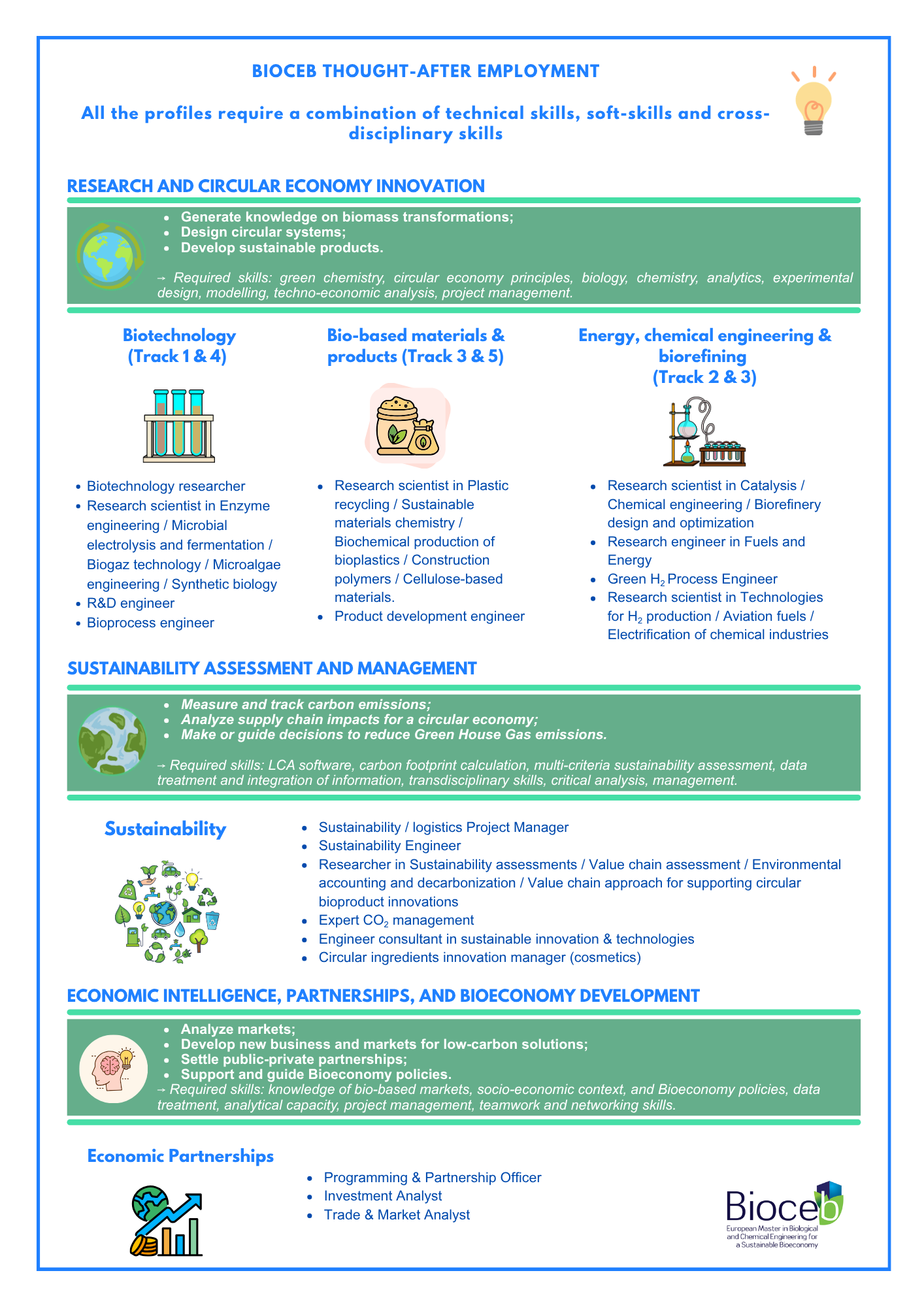
Thanks to their international experience and network, the Bioceb graduates will be ensured a wide range of international careers in academia, research, and industry, with impact on CO₂ reduction and climate change mitigation, such as:
- Research scientist (biology, biotechnology, catalysis, polymer science, biorefinery)
- Product or process engineer (bioprocess, biomaterial, biocatalysis, fuels and energy)
- Business developer in bio-based industries
- Start-up or innovation manager
- Consultant in sustainability (innovation & technologies, decarbonisation, value-chain design and assessment)
- Analyst (investment, trade & market)
The employment rate is nearly 90% within one year of graduation (including 50% pursuing PhD programmes).
Funded by the European Union. Views and opinions expressed are however those of the author(s) only and do not necessarily reflect those of the European Union or the European Education and Culture Executive Agency (EACEA). Neither the European Union nor EACEA can be held responsible for them.
Updated June 2026