
Chapeau Chapeau Chapeau Chapeau Chapeau Chapeau Chapeau
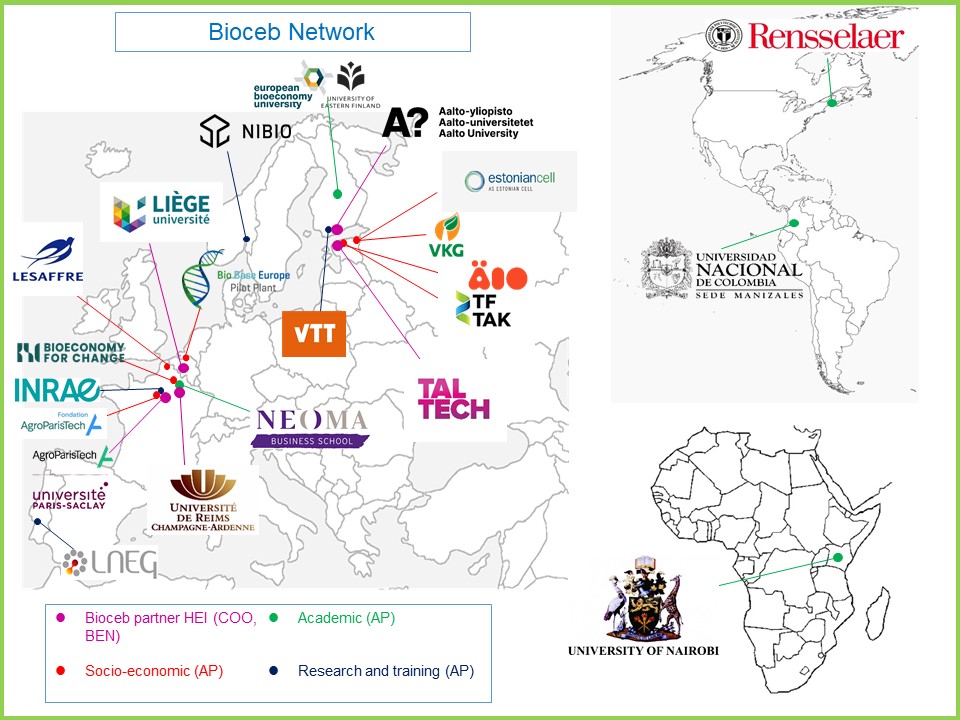
Bioceb Project 2025 - 2031 is supported by an international network of 17 strategic partners from the academic, research and industrial sector.
Several partners contribute to the education and career development, leading to gaining professional competencies and enhancing students’ employability. They act in training, promoting, sponsoring, and advisory activities to make Bioceb a professional training programme adapted to today’s and tomorrow’s market needs. Bioceb includes different socio-economic networks, to ensure that bioeconomy main industrial actors (SMEs and multinationals) are associated with the project.
The selected associated partners are actors of innovation with international visibility in the bioeconomy field. They are involved in multidisciplinary activities combining chemistry and biotechnology for the conversion of biomass. They include regional clusters representative of socio-economic local networks as well as several companies (SME or multinationals), research organisations, and internationally-renowned universities, building thus a balanced network supporting Bioceb needs: promotion and recruitment of excellent students from all over the world; guest lectures contributing to academic excellence and socio-economic connection of Bioceb; access to infrastructures and site visits; contribution to employability, notably through internships and master’s thesis offers. Their distribution at the international scale ensures to cover world regions with different bioeconomy models and develop the global vision of the students.
List of Bioceb Associated Partners
- ÄIO - Estonia – Estonia
- AS Estonian Cell – Estonia
- Bio Base Europe Pilot Plant (BBEPP) – Belgium
- Bioeconomy For Change (B4C) – France
- Center of Food and Fermentation Technologies (TFTAK) – Estonia
- AgroParisTech Foundation - France
- Lesaffre International SARL – France
- The National University of Colombia (UNAL) site of Manizales, Institute of Biotechnology and Agroindustry – Colombia
- The National Laboratory of Energy and Geology (LNEG) – Portugal
- The National Research Institute for Agriculture, Food and the Environment (INRAE) - France
- Neoma Business School - France
- Norwegian Institute of Bioeconomy Research (NIBIO) – Norway
- Rensselaer Polytechnic Institute – United States
- Technical Research Centre of Finland VTT - Finland
- University of Eastern Finland (UEF) – Finland, as Chair of the European Bioeconomy University (EBU)
- University of Nairobi – Faculty of Agriculture - Kenya
- VKG Fiber OÜ, Estonia
Contributions may include on-site training, participation in scientific workshops and Bioceb international seminars, topic proposals for internships and master’s thesis, sponsorships of students or events, circulation of job or internship proposals, dissemination of the programme, contribution to the quality assessment, etc.
Funded by the European Union. Views and opinions expressed are however those of the author(s) only and do not necessarily reflect those of the European Union or the European Education and Culture Executive Agency (EACEA). Neither the European Union nor EACEA can be held responsible for them.
Updated May 2026